




New article published in Journal of Optical Communications and Networking
Design of a Key Management System for Efficient Key Supply in Quantum Key Distribution Networks
-
- Department of Telecommunications, Faculty of Electrical Engineering, University of Sarajevo, Zmaja od Bosne bb, Sarajevo, Bosnia and Herzegovina
-
- Department of Telecommunications, Faculty of Electrical Engineering, University of Sarajevo, Zmaja od Bosne bb, Sarajevo, Bosnia and Herzegovina
-
- Department of Telecommunications, Faculty of Electrical Engineering, University of Sarajevo, Zmaja od Bosne bb, Sarajevo, Bosnia and Herzegovina
- Miroslav Voznak
- VSB – Technical University of Ostrava, Ostrava, Czechia
-
- Department of Telecommunications, Faculty of Electrical Engineering, University of Sarajevo, Zmaja od Bosne bb, Sarajevo, Bosnia and Herzegovina
- VSB – Technical University of Ostrava, Ostrava, Czechia
Abstract
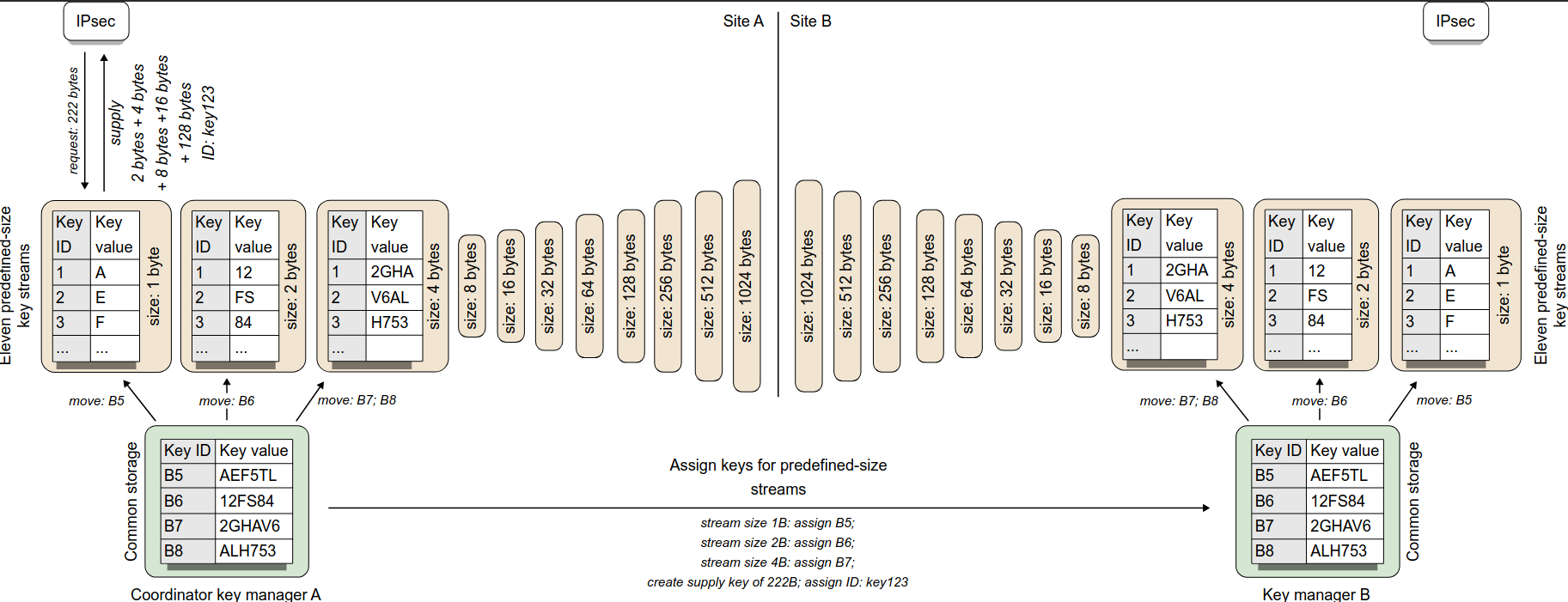
Key management strategies are a critical yet often overlooked aspect of integrating Quantum Key Distribution (QKD) networks as a service into critical infrastructure. It has a considerable impact on the efficiency of QKD network services, thereby shaping its suitability for diverse applications. In this paper we examine the effectiveness of key management strategies developed through practical testbeds, identifying their strengths and weaknesses. A novel organization of key storage to enhance key construction efficiency and overall service performance is introduced. Using simulation tools, the proposed strategy is evaluated against existing approaches, demonstrating superior performance and effectiveness.
DOI
URL
Article is available via url: https://doi.org/10.1364/JOCN.577670
Citation
Dervisevic, E., Tankovic A., Kaljic, E., Voznak M. and Mehic, M., 2025. Design of a Key Management System for Efficient Key Supply in Quantum Key Distribution Networks. Journal of Optical Communications and Networking., doi: 10.1364/JOCN.577670 Impact Factor: 4.3 (Q1/2025)
Journal Title
Journal of Optical Communications and Networking
Publisher
IEEE
Impact Factor
4.3 (2024)


